
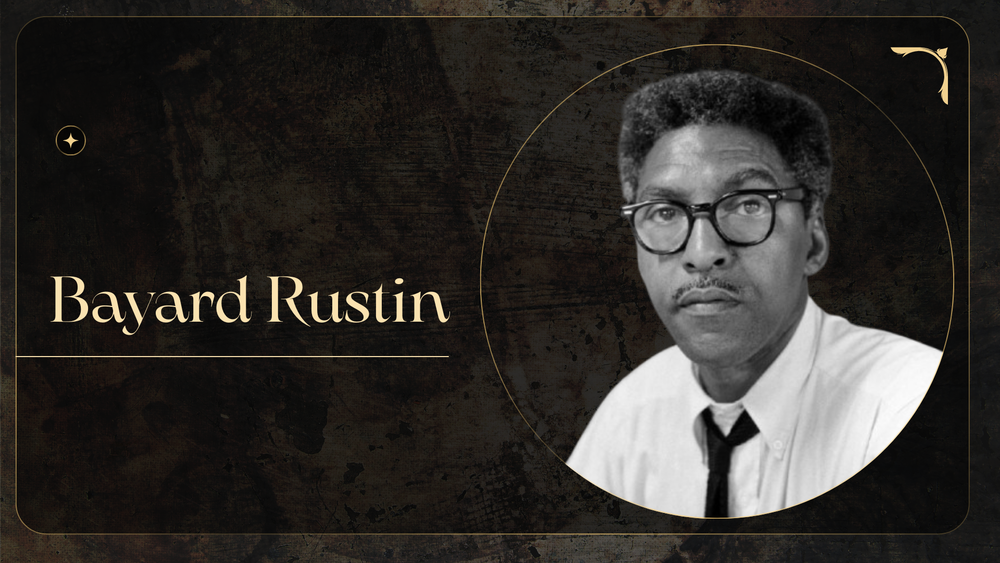
Bayard Rustin was an highly talented strategist, pacifist, and innovative civil rights activist during the mid-20th century. In 1947, as a member of the Fellowship of Reconciliation, Rustin organized the "Journey of Reconciliation," which served as a model for the Freedom Rides of the 1960s. He mentored Martin Luther King Jr. in nonviolent civil resistance and was a key thought leader and organizer behind the expanding civil rights movement during the 1950s and 1960s. Additionally, he organized protests in England and studied Gandhian principles in India.
Born in 1912 in West Chester, Pennsylvania, Rustin was raised in a Quaker family that was actively involved in civil rights advocacy. He attended Wilberforce University, Cheney State Teachers College, and City College of New York. A charismatic individual, he earned a living as a spiritual singer performing in nightclubs in New York City. He briefly expressed interest in the Communist movement and remained a lifelong pacifist, influenced by his Quaker upbringing. His dedication to civil and human rights often came with personal sacrifices; he was arrested multiple times and spent time in jail on two occasions.
In the 1940s, Rustin met A. Philip Randolph and collaborated with him on various proposed marches on Washington, D.C., to protest segregation in the armed forces and the defense industry. Their partnership led to Rustin being appointed as Deputy Director and overall logistical coordinator for the March on Washington for Jobs and Freedom in 1963. In 1947, Rustin and George Houser, executive secretary of CORE, organized the Journey of Reconciliation, which was the first of the Freedom Rides. The Rides aimed to challenge the Supreme Court's ruling against racial discrimination in interstate travel. Rustin was arrested for violating state laws related to segregated seating on public transportation and served twenty-two days in detention.